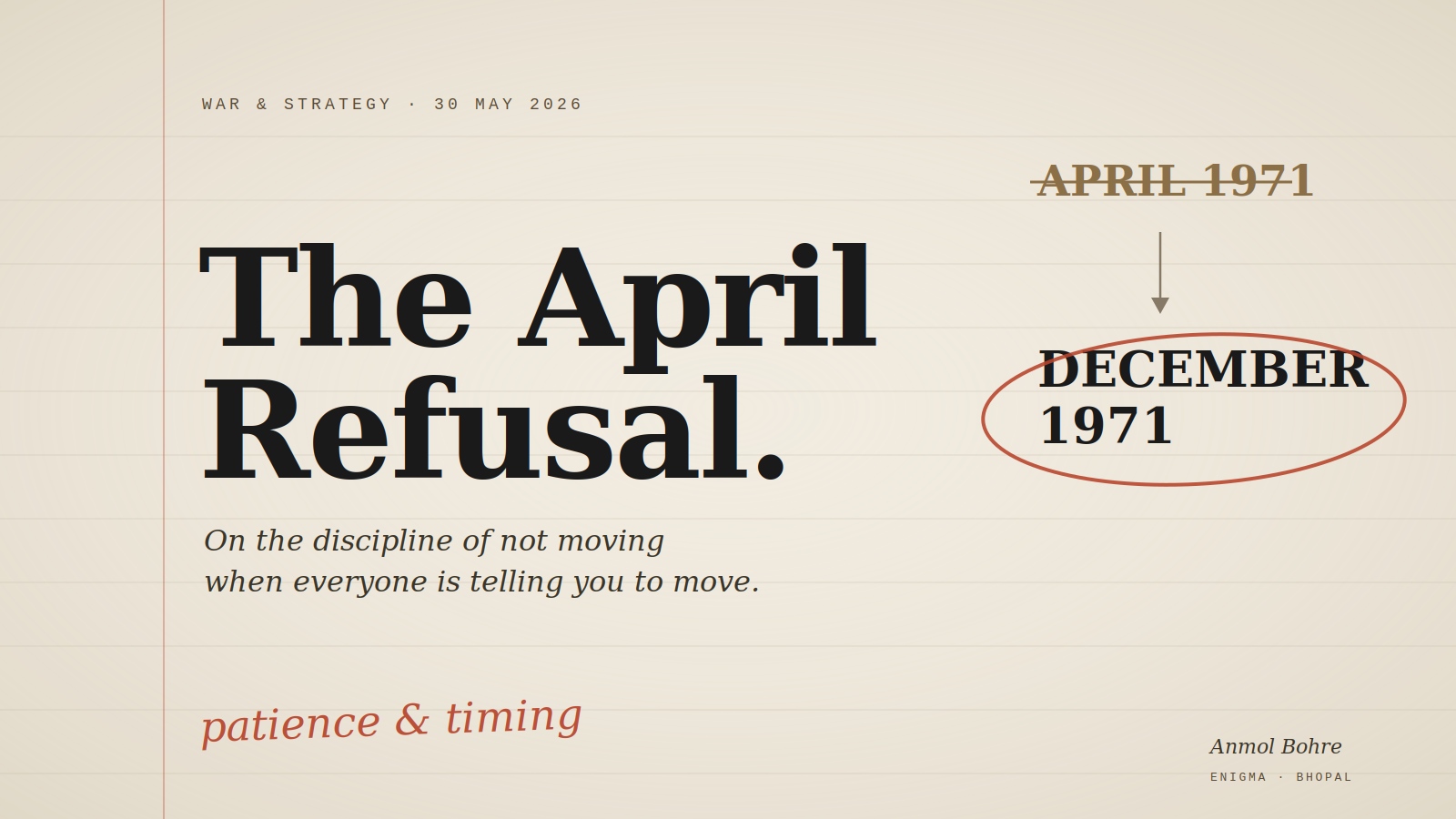
The April Refusal
There's a story they teach you about Sam Bahadur. They tell it wrong, mostly. Let me tell it the way it's worth remembering.
April 1971. East Pakistan was on fire. Tikka Khan's army was killing civilians by the hundreds of thousands. Refugees were pouring across our border into Bengal, Assam, Tripura at a rate India simply could not absorb. Chief ministers were on the phone to Delhi every morning. The opposition was demanding action. The press wanted blood.
Indira Gandhi was under enormous pressure to do something.
She called a cabinet meeting. She summoned her Army Chief.
Now, here's where the historians fight a little. The popular version of what happened next is Sam Bahadur's own. He was, in the words of one writer, "a gifted raconteur" — which is the polite way of saying he sharpened the story over thirty years of telling it at dinner parties.
His version goes like this. The Prime Minister, grim-faced, ordered him to march into East Pakistan. He refused.
"I have 30 tanks. Two armoured divisions. The Himalayan passes are about to open. What if the Chinese come down? The monsoon is about to start in East Pakistan, and when it rains there, the rivers become oceans. If you send me now, I guarantee 100 percent defeat."
He offered to resign on the spot.
She refused the resignation. She asked instead: when will you be ready?
He told her: December.
In December 1971, India won that war in thirteen days. 93,000 Pakistani soldiers surrendered at Dhaka. A new country was born. Gandhi was called Durga. Sam Bahadur became Field Marshal.
(The footnote the historians make us add: Indira Gandhi probably never seriously intended to invade in April. She knew the army wasn't ready. The cabinet meeting was partly her managing her own hawks. Sam Bahadur later embellished the story over the years. Fair enough. The principle survives the editing.)
Because the principle is real. And it's the most underrated skill in any business you'll ever build:
The discipline of refusing to move on someone else's timeline.
Every founder I know has had an April 1971.
A board member who wants the launch pulled forward. An investor pushing for a number this quarter that the product cannot honestly deliver. A dealer demanding inventory before the supply chain has stabilised. A co-founder absolutely convinced that the market will move on if we don't act now. A spouse, sometimes, gently asking why the breakthrough is taking so long. (My answer to that one is usually "soon, jaan, soon" and then I change the subject, but that's a different post.)
All of them are well-intentioned.
All of them are right that something needs to happen.
All of them are wrong about when.
The hardest skill in business is not deciding what to do. It is deciding when to do it. And the hardest part of that skill is being willing to look stubborn, slow, or insufficiently ambitious in front of people whose opinion of you you actually care about.
In April 1971, India looked weak. The world watched a million refugees and a seemingly passive Indian government. Domestic critics called Gandhi indecisive. International press wrote her off. Every instinct of leadership was screaming at her to move.
She didn't move.
Because she didn't move, the Indian Army got eight months. Eight months to refit tanks, build forward logistics, train the Mukti Bahini, sign the Indo-Soviet treaty in August that quietly neutralised the American threat, and wait for the Himalayan passes to close so the Chinese couldn't come south. By the time the monsoon ended and December arrived, the entire strategic geometry of the subcontinent had shifted.
The war was won before it began.
Bravado would have lost Bangladesh. Preparation won it.
I think about this often in our industry.
The electric two-wheeler business in India is an industry with a clock on the wall. The PM E-DRIVE subsidy expires July 31, 2026. Sixty-three days.
Every OEM in the country is being told something this week. By dealers. By investors. By the trade press. Sometimes by their own internal teams. The message is always the same: move now. Push volume. Stack the channel. Drop prices. Catch the last wave of subsidised demand before the cheque from Delhi stops arriving.
Some of them will. Some are doing it as I write this.
But there is a question worth asking before you put a crore of inventory into a dealership: what is actually on the other side of July 31? A customer who was quietly buying us all along for the running-cost economics, not the subsidy. A market that printed 1.4 million units last year despite the subsidy already being halved twelve months ago. A consolidation phase where OEMs without working capital discipline will get politely shown the door.
The instinct in April is to chase.
The discipline is to refuse the timeline you are being handed, and build for the war you will actually have to fight.
Sam Bahadur didn't sit on his hands in those eight months. He used them brutally. He trained, he equipped, he positioned, he negotiated, he prepared. The April refusal was not a refusal of action. It was a refusal of the wrong action, at the wrong time, in the wrong weather.
That is the part most people miss when they tell this story badly.
"Patience" is the wrong word for what he did. He wasn't sitting still being zen. He was preparing furiously while looking still. The two look identical from the outside. Inside, they are the difference between losing Bangladesh and winning it.
There's a line I keep coming back to. It's scribbled in my own handwriting at the bottom of an old diary from 2017, in red ink I wouldn't choose today.
Patience and timing.
I wrote that when I was much younger and didn't really know what it meant. I think I'm beginning to understand it now.
Patience without timing is just delay. Timing without patience is just luck.
The thing that won Bangladesh, and the thing that will separate the OEMs still standing in this industry two years from now, is the discipline to hold both at once.
To be still on the outside and absolutely on fire on the inside.
To say abhi nahi without flinching when the whole room wants you to say "let's go."
To know that the war is won in April, by the army that refused to fight in April.
Onwards and upwards. 🇮🇳


All information is subject to specific conditions | Copyright © 2021 Enigma Electric All rights reserved.


